..

Thursday, April 15, 2010

Feed Your Head Stock

I'm in rehearsals this week with the Keith Urban band, getting ready for a show in Phoenix and the ACM Awards in Las Vegas. I'm taking care of Brian Nutter's gear this year, and we're putting the Planet Waves Headstock tuner to good use.


Brian plays electric, acoustic, 6 and 12-string, resophonic, ganjo (6-sting banjo) and mandolin in the show. We're running all these acoustic instruments into a pair of Midas XL 42 dual mic pres, then into a line mixer blend these four inputs into a single output to send the monitor and front of house engineer a single fader to control.


This means that any on-the-spot tuning that Brian might need is done on stage without a mute switch or volume pedal. I send every acoustic instrument out with a Headstock Tuner clamped on.


I use them to first tune the instruments in my world, since the stage volume is usually too loud to use an audio-based tuner. By sensing the vibrations through the headstock, the Headstock Tuner doesn't really care how loud the band is, how close you are to a raging half-stack, how loud the crowd is cheering. They work great on electric guitars, too. I also send one out on the 12-string headstock of the white Gibson EDS-1275 doubleneck that's capoed with an NS capo at the 3rd fret...just in case!

Monday, April 5, 2010

The $.25 EQ

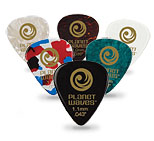
Picks. Everybody has lots of picks, everybody has lost a lot of picks. Once you find a gauge and texture you like, most people stick with it and don't give it another thought. But picks are the least expensive way to change your tone, explore new sounds, and create a wider palette of tones in the studio.

Planet Waves makes a variety of picks for just about every occasion.

Our Duralin picks are the most popular. Made from Acetyl or Delrin™, Duralin picks have a perfect blend of stiffness and spring. They're extremely durable and last a long time. In fact you'll probably lose it before you use it. Duralin picks accentuate the attack of a note, giving clarity and power to every pick stroke.


Duralin Picks


Classic Celluloid. No, it's not a Charlie Chaplin film festival, it's the Planet Waves version of the perennial favorite guitar pick. A softer, less aggressive tone than the Duralin, Celluloid picks were the favored substitute for actual tortoiseshell, and it fact Fender's #351 medium gauge tortoiseshell pick might be the most famous pick of all time. Planet Waves offers celluloid picks in a variety of colors and gauges. Great for strumming acoustic guitars and for when you want a little warmer sound. A thin celluloid playing a high-capo part is a great trick to use when doubling a track in the studio.


Classic Celluloid


Delflex. The blending of nylon and acetyl, these injection molded picks and long-lasting and bright. Injection molding gives the pick familiar flexibility in all directions, as opposed to stamped sheet picks, which can break and tear if bent in the "wrong" direction. Quick on the attack with a bit of give, striking a nice balance between the Duralin and the Classic Celluloid. Great for bass guitars that need some snap on the attack, but without the click.


Delflex


The SurePick is a Planet Waves innovation. An injection molded rubber grip (in the shape of the Planet Waves logo) makes this pick a great choice for slippery fingers and bass guitarists. You can really dig in to the strings without fear of losing your grip. (Hold one up to the light and check out what the logo on each side of the pick turns into...!)


SurePick

Black Ice
picks are Planet Waves' latest offering. Duralin picks formed into the popular Jazz shape and tumbled like fine jewels for a soft texture with a stiff attack. Perfect for ripping, articulate leads and heavy rhythm.

Black Ice

All of these picks will make you guitar respond and react differently. Next time you're at the music store, grab a handful of picks of several different gauges and materials. Try playing the same piece of music, song or favorite lick and vary the pick you use. Listen to what it does to the attack of the string. Bright and immediate? Soft and warm? Quick and aggressive? Listen to how the different picks accentuate the sound of your electric guitar. Turn them around and use the rounded edge instead of the point. This is a common trick used by Bluegrass pickers.

Spend some time exploring the Planet of Picks... and make your own Planet Waves.

Thursday, April 1, 2010

Tuesday, March 9, 2010

Creative Capos

The capo has been around since the 17th century. Capos, from the Italian phrase “capo tasto” meaning “head fret”, are used to change the pitch - or transpose - various stringed instruments without re-tuning. Certain chord voicings, like the open-position G chord on a guitar, have a distinctive sound that cannot be completely captured by barring the strings. Bluegrass guitar, in particular, features the “Lester Flatt G-run” that is impossible to play correctly (with its distinctive open strings and hammer-ons) without a capo.

Capos are also used on 12-string guitars to play in concert pitch. Some guitarists like the bigger sound you get by using medium strings, which can put a lot of tension on an acoustic 12-string and make fingering difficult. By tuning down a whole step and capoing on the second fret, you get the extra thump of a medium gauge with the easier fingering of reduced string tension.

Some players with less appreciation of the importance of open chord voicings and string tension (and it’s effect on timbre) call capos “cheaters”. While it’s true that using a capo allows the “three-chord guitar player" the opportunity to play in any key without learning a new chord grip, capos can be used in more creative ways. In fact, a beginning guitarist with a capo can play many things that a professional without one cannot. You’d be cheating your music by not investigating the many uses of a capo.

The most obvious use is to simply change the pitch of the strings by capoing on any fret and playing the chords to the song as you would in the open, un-capoed position.


G chord in open position


G chord capoed at second fret is now an "A" chord

This is especially helpful when you have learned a song using open chords and have to play it in a different key. For example, female singers who are covering songs originally sung in lower keys benefit from this use of a capo. Guitar players gigging with a female singer-songwriter will often find themselves in the keys of B, Eb, Ab, Db and other keys that are simply guitar un-friendly. Capos are an essential tool in your gig bag.

Another great use for the capo is in the recording studio. When layering guitar tracks, it often sounds good to play a second acoustic track while capoed up several frets. The blend of the two chord voicings and timbres creates a warm, rich foundation for a track. You can also use a capo and play just the top three or four strings on the doubled part to get a faux-12 string sound.

Capos can also give you the sound of a “dropped-D” tuning. By placing a capo on strings 5 through 1 (the A, D, G, B and High E) at the second fret, leaving the Low E open, you get the sound of a dropped D tuning in the key of E. This allows you to use the friendlier D, G and A shapes in the key of E and gives you the solid bass note of the tonic E chord.


Capo at 2nd fret, with open E string

Planet Waves makes the NS Trio capo for this purpose. Partial capoing on an acoustic guitar is one part of the Trio concept, additionally it is a great capo for both mandolins and banjos. The Trio capo is shorter than a standard capo, and covers 5 strings of a standard guitar. Planet Waves also offers a Classical Capo, which is long enough to cover the width of a classical/nylon string guitar neck and is machined to fit it’s typically flattened fingerboard.

Once you’ve tried the “Dropped-D” trick using an open string in E, you can use two capos to get the same voicings in other keys. Try putting a standard NS capo across all six strings at the third fret and a Trio capo on strings 5 through 1 at the 5th fret. Now you can play in C using the "G chord" shape as your I chord and have your V chord (in this case, the G chord played in a D-shape voicing) still have plenty of low end.


A C chord using the "G shape" in the 2-capo "Drop D" set up


Playing a G chord in the "Drop D" 2-capo setup

The neat trick to this technique is that you can reach notes between the two capos, for example to fret the A note on the 5th fret to play a VIm (A minor) chord. Your first finger completes the barre at the 5th fret.


Playing an "Em barre shape" (sounding as an Am) in the two-capo setup

That ought to get you started thinking about creative capo uses. Check out all of the excellent capos from Planet Waves at www.planetwaves.com

Tuesday, February 9, 2010

Tru To Life


The latest entry in Planet Wave’s popular pedal tuner line addresses the most common requests we’ve received: A true strobe tuner pedal that can be seen at noon or midnight on any stage. I’ve been using the original TruStrobe on my tech bench for about a year now, and the Chromatic Pedal Tuner on my own pedalboard and that of the guys I tech for.

The new Tru Strobe Pedal Tuner is a mash-up of both...the “guts” of the table top and the body of the stompbox. The LED light have been replaced with an LCD screen with a switchable on/off backlight. The orange background with black numbers and letters is easy to read from every angle an in all lighting conditions. The true strobe nature of the pedal allows extremely accurate on-stage tuning. Simply watch the rotating LCD segments and tune the string until they stop moving. Clock-wise motion means you are flat, counterclockwise means you are sharp. This tuner is accurate to within +/- 0.1 cent.

I had the opportunity to use this tuner in the field recently, when Brian Nutter, guitarist for Keith Urban , added it to his pedalboard for the taping of the CMT Crossroads show with Urban and John Mayer. Brian is fun and challenging to tech for because he started out in this organization ...as Keith’s tech! He loved the tuner and I ended up leaving it on his board even thought it was my only sample at the time. Not only is it an accurate and easy to use tuner, but it looks great doing it. The black chrome housing is stylish and unobtrusive and takes up minimal space on your board.

Standard 9v battery power and AC input jacks, including a daisy-chain output to power more pedals. The Tru Srobe pedal is also true bypass.

A great addition to your onstage rig, this pedal is accurate enough to be your ONLY tuner...at the gig, on the work bench and in the studio.

Tuesday, August 11, 2009

The PW-CT-10 Headstock Tuner Live Onstage With Keith Urban

Hey Everyone-

This is Tom with Planet Waves Artist Relations checking in while I'm on the road with Keith Urban. One of the great perks of working for Planet Waves is getting to try their products in many different scenarios. On stage in a club, in the studio, offstage in an arena, on a tour bus, wherever a guitar needs tuning.

I shot this short video at a recent Keith Urban concert, with the noisy crowd and blaring P.A. in the background to prove a point. The Planet Waves Headstock Tuner works under fire, no matter what the ambient noise around you might be. By reading the vibrations transmitted through the headstock, and not relying on a pickup reading an audible string pluck, you can tune a sensitive instrument like a banjo with no problems. I put a Headstock Tuner on every guitar, banjo and mandolin that goes on stage. Check it out!

Tuesday, July 21, 2009

Richard Gilewitz - New Zealand Clinic Tour

Richard Gilewitz here from the other side of the planet to talk about the great Planet Wave products and D'Addario Strings as I travel through the entire country of New Zealand for my 5th tour in 8 years.

Currently as of this writing I am midway through the tour and just about to finish up on the South Island. Not exactly looking forward to the 3 hour ferry ride to the North Island this weekend (although it is a beautiful trip) since I was apparently born without proper sea legs. Nothing a bag of chicken flavored potato chips and ginger beer won't cure!

Had a fantastic time during the first half of the trip, apparently no issues with jet lag (this time) and have had many opportunities to demo a multitude of great products.

Trevor Daley at MusicWorks in Invercargill (the furthest city south in the world - Antarctica is next spot down) did a bang up job promoting the concert/seminar event drawing a crowd of well over 110 folks and the hottest giveaway 'swag' items for the evening were the Planet Waves Humidifier, 3 phase guitar polishes, SOS tuners, and EXP D'Áddario Strings.


Several musicians in the audience also approached me after the event and appeared to be utterly fascinated with the circuit breaker cable as well as my stated 'string life' mentioned during my performance.

Trevor was also kind enough to change my strings on my Breedlove Signature 6 string model and was grateful for the use of my Planet Wave Peg Winder complete with the string cutting feature.

During my MusicWorks mini-GillaCamp 'hands on' workshop the following night in Gore, Trevor's friend, Peter Cairns was kind enough to host the event drawing 18 attendees for the evening. Until I pulled out my Planet Wave Multi Function Tuner/Metronome the group sounded like a bag of cats when playing together. Once I aligned their timing with the help of the metronome the room sounded like a symphony. Well, almost.

Looking forward to sharing the great products DÁddario was so kind to send for the trip as I travel north ... and really looking forward to those Chicken Chips.

 
..